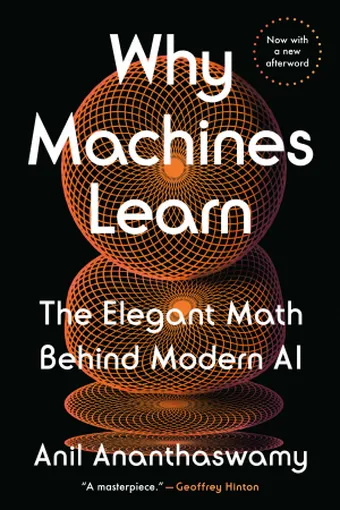
Why Machines Learn by Anil Ananthaswamy is an accessible guide to the core mathematical principles and algorithms powering modern artificial intelligence. Artificial intelligence often appears as a collection of black-box heuristics, yet its breakthrough capabilities rest on elegant mathematical ideas. Ananthaswamy traces how linear algebra, calculus, and probability theory converge to allow machines to learn representations from raw data.
What you will learn
- Trace the mathematical lineage of neural computation from early perceptrons to modern transformer models
- Map how gradient descent navigates high-dimensional non-convex loss surfaces to optimize weights
- Explore the geometric mechanics behind hyperplanes, margin classifiers, and support vector machines
- Examine the role of kernel methods and high-dimensional transformations in non-linear pattern recognition
- Demystify associative memory and probabilistic energy models through Hopfield networks and Boltzmann machines
- Analyze why overparameterized neural networks generalize well rather than overfitting training data
- Evaluate how attention mechanisms enable context-aware representations in transformer architectures
Who this is for
Software developers, data professionals, students, and curious technical readers who want to understand the foundational mathematics of AI without getting lost in dry notation. Basic high school algebra and a general curiosity about machine learning are sufficient.