AI EngineeringIn Stock
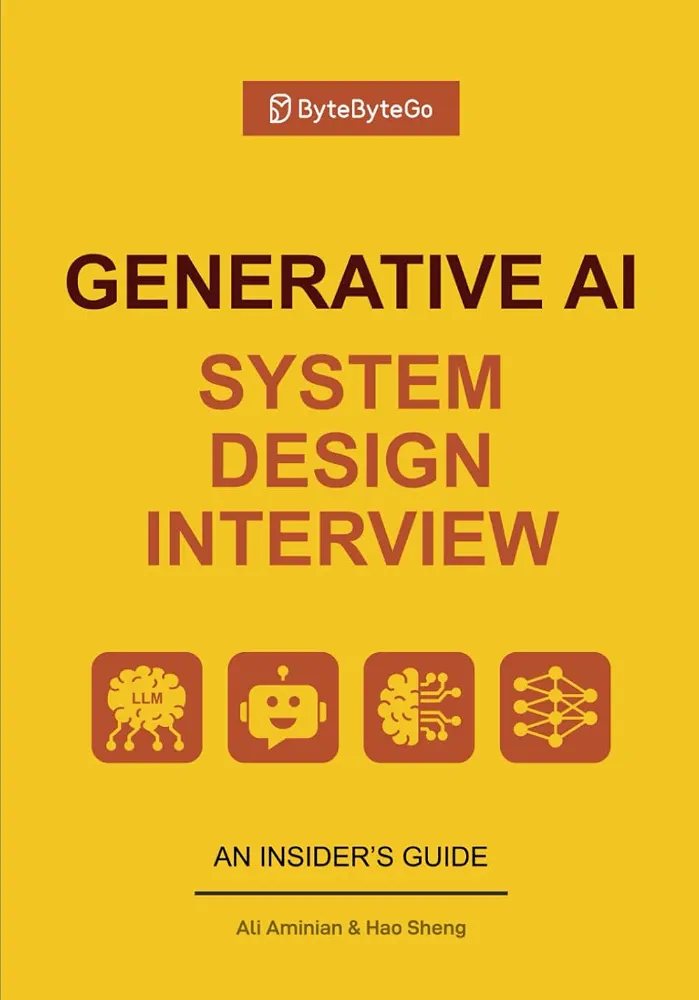
Generative AI System Design Interview 1st
A Practical Guide for ML Engineers and AI Candidates
Price৳ 350
Generative AI System Design Interview is a visual, interview-focused guide for engineers who want to design real GenAI systems and explain them with confidence. Published by ByteByteGo, the team behind Alex Xu's popular system design books, and written by Ali Aminian and Hao Sheng, it teaches you how to think like a candidate who gets the offer, not just how to memorize answers.
Most AI books explain how models work. This one shows you how to turn those models into complete, production-ready systems and how to present them clearly in an interview.
What Makes This Book Different
- A 7-step framework you can reuse on any GenAI design question, so you never freeze when the problem is new.
- 10 real-world system design questions with in-depth solutions, each one a realistic interview scenario.
- 280+ diagrams that make complex architectures easy to understand at a glance.
- An insider's view of what interviewers actually look for and how they judge your trade-offs.
- A companion to ML System Design Interview, so you can move from classic ML systems to modern generative ones.
What You Will Learn
- How GenAI systems are structured, from data and model choice to training, evaluation, and deployment
- How to design smart text-completion and email assistant features like Gmail Smart Compose
- How machine translation systems such as Google Translate are built
- How to design a ChatGPT-style personal assistant
- How image captioning systems work
- How Retrieval-Augmented Generation (RAG) helps models answer with up-to-date, grounded knowledge
- How to design systems for realistic face generation, high-resolution image synthesis, text-to-image generation, and personalized headshot generation
- How text-to-video generation systems are approached
- How to discuss trade-offs such as quality, latency, cost, scale, and safety like a senior engineer
Why Readers Choose This Book Over Others
Many AI books are heavy on theory and light on interview practice. This book is built around the exact question formats used in ML and GenAI interviews. Instead of long academic chapters, you get step-by-step designs, clear diagrams, and a repeatable method. That balance of practical depth and visual clarity is why it is popular with candidates preparing for top tech company interviews.
Who This Book Is For
- Machine learning engineers preparing for ML or GenAI system design rounds
- Data scientists moving toward AI engineering roles
- Software engineers who want to understand LLM, diffusion, and RAG-based products
- Students and career switchers aiming for AI roles at leading tech companies
- Anyone who wants to learn how modern generative AI products are designed end to end
Frequently Asked Questions
Who is this book for?
It is written for ML engineers, data scientists, and software engineers preparing for generative AI system design interviews. Basic machine learning knowledge helps, and the framework guides you step by step.
Is it only for interviews?
No. The interview focus keeps it practical, but the case studies also help working engineers who want to understand how real GenAI products are designed.
Does it cover RAG and chatbot systems?
Yes. It includes a ChatGPT-style personal assistant and a dedicated Retrieval-Augmented Generation chapter.
Does it cover image and video generation?
Yes. It covers text-to-image, high-resolution image synthesis, face generation, personalized headshots, and text-to-video generation.
How is it different from ML System Design Interview?
ML System Design Interview focuses on classic systems such as search and recommendation. This book focuses on generative systems such as LLMs, diffusion models, and multimodal generation. Together they cover a wide range of interview topics.
Should I read other resources too?
This book is an excellent interview trainer. For the newest topics such as agents and tool use, pair it with current documentation and practice.